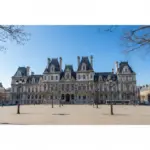

Paris, June 5 – A proposal put forth by Clément Beaune, High Commissioner for Planning and Commissioner General of France Stratégie, on Wednesday, June 3, 2026, has reopened discussions surrounding the future of Grand Paris. Beaune’s vision suggests reorganizing the metropolitan area into around forty districts, a move that could extend the capital’s institutional limits beyond its current boundaries.
Rethinking Metropolitan Organization
This proposition is not merely about annexing neighboring communes, as was seen in the 19th century. Instead, it aims to fundamentally rethink the organization of the metropolitan core, transcending the existing divisions between Paris, its arrondissements, the inner suburbs, departments, and the Métropole du Grand Paris.
The concept of 40 districts would establish a new territorial framework: broader than the Parisian arrondissements but more localized than a single, large metropolitan structure. These districts could encompass Parisian neighborhoods and adjacent communes, or several communes within the inner suburbs.
As of now, no definitive map has been established, and the reform remains purely at the proposal stage.
The First Circle: Communes Bordering the Périphérique
The first communes likely to be affected are those directly adjacent to Paris. These are the areas in immediate contact with the périphérique, the portes de Paris, major transportation arteries, metro and tram lines, and metropolitan development projects.
- To the west: Neuilly-sur-Seine, Levallois-Perret, Clichy, Saint-Ouen-sur-Seine, Boulogne-Billancourt, Issy-les-Moulineaux, and Vanves.
- To the south: Malakoff, Montrouge, Gentilly, Le Kremlin-Bicêtre, Ivry-sur-Seine, Charenton-le-Pont, and Saint-Mandé.
- To the east and northeast: Vincennes, Montreuil, Bagnolet, Les Lilas, Le Pré-Saint-Gervais, Pantin, Aubervilliers, and Saint-Denis.
The Second Circle: The Entire Inner Ring (Petite Couronne)
A broader scenario would involve the entirety of the ‘petite couronne,’ comprising the three departments surrounding Paris: Hauts-de-Seine, Seine-Saint-Denis, and Val-de-Marne.
In this case, the reform would not be limited to communes bordering the périphérique. It could extend to cities further from Paris but already integrated into the metropolitan fabric, such as Nanterre, Courbevoie, Colombes, Rueil-Malmaison, Antony, Créteil, Champigny-sur-Marne, Vitry-sur-Seine, Maisons-Alfort, Bobigny, Drancy, Aulnay-sous-Bois, Noisy-le-Grand, Bondy, Sevran, or Rosny-sous-Bois.
The Third Circle: The Current Perimeter of the Métropole du Grand Paris
The most extensive scenario could adopt the current perimeter of the Métropole du Grand Paris. This entity currently includes Paris, the communes of Hauts-de-Seine, Seine-Saint-Denis, and Val-de-Marne, along with seven communes located in Essonne and Val-d’Oise.
The Métropole’s website states that it encompasses the City of Paris, the communes of the three inner-ring departments, and seven outer-ring communes:
- In Essonne: Athis-Mons, Juvisy-sur-Orge, Morangis, Paray-Vieille-Poste, Savigny-sur-Orge, and Viry-Châtillon.
- In Val-d’Oise: Argenteuil.
Varying Degrees of Impact
It is crucial to note that not all communes would be affected in the same way, even if the reform adopted the perimeter of the Métropole du Grand Paris.
Cities directly bordering Paris would likely be central to any redrawing of boundaries, as they share immediate challenges with the capital: the périphérique, the portes de Paris, urban continuity, transport, offices, housing, roads, and pollution.
More distant communes would be impacted by issues of governance, financial solidarity, urban planning, or major infrastructure projects. Their daily administrative routines might evolve, but they would not necessarily be ‘integrated into Paris’ in the strict sense.
The proposal is currently under review, and further details are expected as discussions progress.
Source: sortiraparis.com