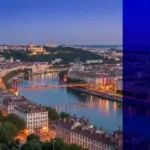

Lyon, a city renowned for its rich architectural heritage, is currently at the forefront of a pressing climate challenge. As extreme heatwaves become the new norm, the urgency to adapt housing for thermal comfort clashes with stringent patrimonial regulations, creating a complex battle between public health, urban planning, and historical preservation. This summer alone, Lyon has endured five heatwaves, with a record-breaking 34 consecutive days above 30 degrees Celsius between June 16 and July 19, shattering the previous 2006 record.
The Clash: Modern Comfort vs. Historic Preservation
The most contentious point in this debate is the installation of air conditioning units. Quentin Miramand, head of Miramand électricité, expresses frustration over the numerous project refusals due to heritage classifications. “It’s complicated to install air conditioning in central Lyon because it’s classified almost everywhere. The rules set by the Architects of Bâtiments de France are too nebulous; there’s no clear regulation, it’s pretty much at their discretion,” he states.
Lyon’s historic center, including parts of Caluire-et-Cuire, Sainte-Foy-lès-Lyon, and La Mulatière, is designated as a protected site, subjecting it to specific regulations. Historic monuments and remarkable heritage sites in Old Lyon and the slopes of Croix-Rousse also fall under these protective measures. Miramand argues, “I’ve had several project rejections in the 6th arrondissement because the buildings are classified. When we get a refusal, we can’t go any further. The goal isn’t to denature the building, as the architecture is beautiful, but a compromise must be found. There are solutions, like installing internal units, but these are also refused.”
Legal Battles and Ambiguous Regulations
The struggle has escalated into legal disputes. A property owner in the Rue de Sèze (Lyon 6th) had his request to install an outdoor unit on his building’s roof denied by the City of Lyon, citing patrimonial interest. His appeal to the administrative court was unsuccessful. Similarly, a resident of Rue Edouard-Herriot (Lyon 2nd) was denied permission to install an air conditioner in her building’s courtyard, with the administrative court upholding the municipality’s decision.
Yasmine Bouagga, Mayor of the 1st arrondissement, acknowledges the problem: “We need to find concrete solutions with the ABF and social landlords, but it’s not true that we cannot intervene in protected areas. We are working to establish a repertoire of compatible solutions: jalousies, wooden shutters…”
Despite these setbacks, some appeals have succeeded. An inhabitant of Vaise (Lyon 9th), whose request for an outdoor air conditioning unit was initially refused, saw the administrative court rule in her favor, citing an “error of assessment” by the city. This suggests a potential shift in judicial interpretation, emphasizing the need for practical solutions over rigid adherence to regulations.
Beyond Air Conditioning: Holistic Adaptation and Social Equity
The debate extends beyond air conditioning to broader thermal comfort solutions. GrandLyon habitat recently undertook a renovation project in a 7th arrondissement residence, focusing on insulation and ventilation, with the approval of Bâtiments de France. Sacvl reports that “92% of our housing units are already equipped with solar occultation devices.”
However, many tenants lack basic sun protection. In the 1st and 4th arrondissements, 62% of homes are without such devices, rising to over 90% in some streets. The law doesn’t mandate these installations, leaving tenants to improvise “makeshift sun protection” at their own expense, as highlighted by the association Locataires ensemble.
Public Intervention and Future Prospects
In response to the escalating crisis, the City of Lyon is taking a more proactive stance. Recognizing excessive heat as a health issue rather than just a comfort concern, the municipality announced its intention to declare excessively hot dwellings as unfit for habitation, thereby compelling landlords to undertake necessary renovations. Mayor Grégory Doucet has approached the Rhône prefecture to secure a “prefectural decree to legally secure this approach.”
Furthermore, a municipal aid fund for installing shutters, blinds, and air circulators is planned for summer 2027. This initiative becomes even more critical given that nearly 700,000 thermally inefficient homes (classified F and G) could re-enter the rental market if the “housing revival” bill, presented by Housing Minister Vincent Jeanbrun, is adopted. Locataires ensemble warns, “92% of these ‘thermal sieves’ are already on the market, so in the name of housing access, we are playing with tenants’ health.”
The situation in Lyon is a microcosm of a larger societal challenge: how to balance the preservation of historical identity with the urgent demands of climate adaptation and social equity. The city’s struggle highlights the need for flexible regulations, innovative solutions, and a collaborative approach involving all stakeholders to ensure that Lyon remains a livable and sustainable city for all its residents.