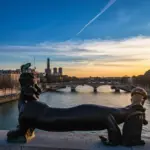

Paris, June 3, 2026 – French President Emmanuel Macron and his Rwandan counterpart Paul Kagame inaugurated a national memorial dedicated to the victims of the 1994 Rwandan Tutsi Genocide on Tuesday, June 2, in Paris. Situated on the Habib-Bourguiba esplanade, along the Seine, this monument serves as both a tribute to the approximately 800,000 victims exterminated within one hundred days and a new milestone in France’s ongoing work of remembrance concerning its role during this tragedy.
“The Archive”: A Memorial of Reflection and Remembrance
Designed by artist Grada Kilomba and titled “The Archive,” the memorial consists of two black brass steles erected on a volcanic stone slab. Its deliberate simplicity encourages contemplation and reflection rather than monumental display. In his speech, Emmanuel Macron, quoting Vincent Duclert, president of the Rwanda commission and historian of the Armenian Genocide, emphasized that this monument now inscribes “the Tutsi Genocide at the heart of our capital and our history.” The head of state also hailed “the culmination of a long and patient work of truth,” referring to the process undertaken in recent years to clarify French responsibilities in the events that preceded and accompanied the genocide.
A New Chapter in Franco-Rwandan Relations
This inauguration follows Emmanuel Macron’s speech in Kigali in 2021, where he acknowledged France’s “responsibilities” in a chain of events that led to the genocide, without, however, speaking of complicity. Since then, relations between Paris and Kigali have seen a spectacular rapprochement, with this memorial now standing as one of its most visible symbols. Alongside the French president, Paul Kagame praised the importance of this act of remembrance, which enshrines the place of the Tutsi Genocide in French national memory. Beyond Franco-Rwandan relations, the ceremony conveyed a more universal message: the refusal of oblivion in the face of mass crimes and the necessity to combat all forms of denial.
A Universal Message Against Genocide and Denial
This universal dimension resonated particularly with representatives of other peoples marked by genocidal experiences. Among the invited personalities were Séta Papazian, president of Collectif VAN (Armenian Vigilance Against Denial), and Ara Toranian, present on behalf of the Coordination Council of Armenian Organizations of France (CCAF). Their presence, alongside that of Vincent Duclert, highlighted that the fight against genocidal phenomena cannot be fragmented according to eras or national affiliations. Whether it be the Armenian Genocide of 1915, the Shoah, the Tutsi Genocide, or other mass crimes, the duty of remembrance constitutes a common struggle against the trivialization of hatred, the erasure of victims, and the falsification of history.
Paris: A City of Universal Memory
The choice of the monument’s location is also significant. Situated on the banks of the Seine, it faces a Parisian area already marked by several places of memory dedicated to the great tragedies of the 20th century, including the statue of Komitas directly opposite on the other bank of the Seine. Paris thus affirms its vocation to carry a universal memory of genocides and crimes against humanity, as Emmanuel Grégoire, the capital’s mayor, recalled in his speech. At a time when hate speech, revisionism, and identity-based violence are experiencing new resurgences across the world, the inauguration of this memorial reminds us that memory is not only a tribute to the dead but also a vigilance addressed to the living.
Source: https://www.armenews.com/a-paris-un-memorial-pour-les-victimes-du-genocide-des-tutsi-la-memoire-comme-rempart-universel-contre-les-crimes-de-masse/